HISTORY
Robert Jonathan “Rob” McGaw
1949 to 1982
Son to Carrie Proctor and Ted McGaw, brother to Laurie McGaw
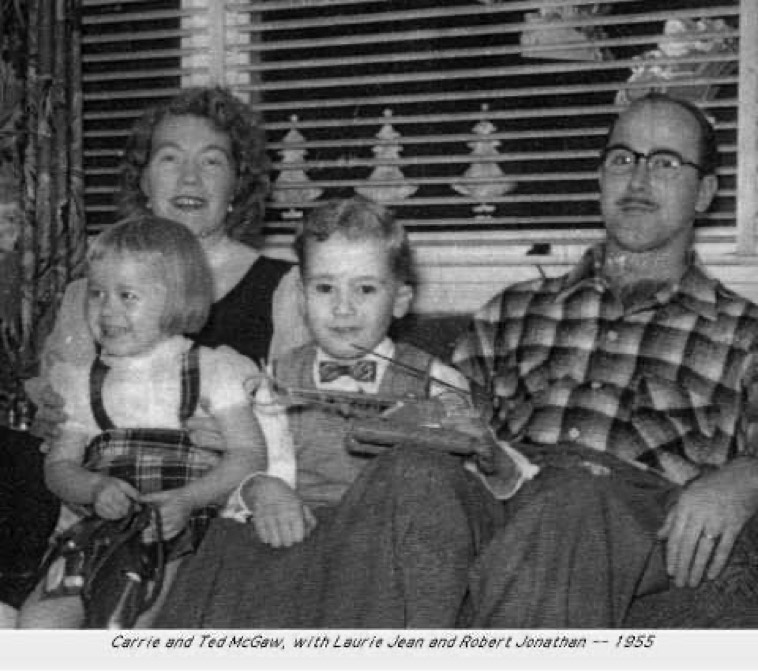
Remembering Rob, By Jim Fenning:
Beyond anything that is already in print or has been said about Rob; I think of him often and I miss him and I still struggle with his death. He died the same year as his Father.
When I changed careers some years after Rob’s death, I was asked why the change of course, and my answer referred back to Rob, as it still feels like I have a missing limb or something and I needed to deal with life and death issues in some way; his death changed me in a profound way, and thus the route into Social Work for me.
Remembering Rob: By Laurie McGaw:
Growing up in the suburbs of Toronto in the ‘50’s and ‘60’s my brother Rob and I were happy kids. We lived on a cul-de-sac that backed onto a ravine, with a river running through it. It was a “wild” place to us kids, perfect for exploring, tree climbing and, in the winter, skating. In summer the river wasn’t deep but we’d “go wading” and skipping stones.*
(A story about that follows, a little later.)
There were a number of families, all with kids around our age, living on the street, so we both had a pack of pals to run with. These kids became life-long friends, and we’re still in touch to this day!
Rob was a natural leader. He seemed to be a magnet for the little kids who looked up to him. He’d gather them on the front porch of our house and tell stories and jokes.
One time he made a “spook house” in the cupboard under the stairs. Dangling skeletons and scary masks lit underneath with a flashlight, all made to look like a haunted house at the “Ex” —the Canadian National Exhibition—which was a highlight of every summer.
Rob and I played well together as kids —I actually loved the things he played with. We had a linoleum rug that had roads printed on it, and we played cars on it for hours. He had a great collection of Dinky cars and others. But my favourite toy of his was his Lionel Train set! We’d play with that for days in a row, setting up trees, creating scenery, and loading the cars with logs. (We have this train set in our basement, displayed on a shelf in the “man cave.”)
He also would make model cars, and paint them so carefully, meticulously adding detail. Later he had a microscope, which I thought was really cool. It was so fascinating to see things in such detail—and the slides of cells were beautiful in their complexity.
We shared a bedroom, as my Grammie McGaw lived with us and had the third bedroom. Often we would tell each other the dreams we’d had, just as we woke up. We split the room right down the middle and had to try to keep our toys relatively neatly stored. I remember the wallpaper was of a country fair, with a ferris wheel and kids eating ice cream cones, while holding balloons. Even as a kid I could see that the printing job was a poor one, as the blobs of ice cream were floating above the cones—the colours were “out of register” , a printing term we would learn later.
Grammie McGaw was quite old and frail. She had raised six kids, during the Depression, and it had taken its toll: she had very poor eyesight, no teeth, and a slight limp. (She was born in 1880!) But she was kind, and quietly gentle. I would sit beside her on her bed, and ask her to tickle my arm —I loved how her long thin fingers with slightly longer nails would feel as she softly trailed them up and down my arm, and we would listen to her beloved CFRB radio—something she did for hours every day. Wally Crouter, Betty Kennedy, Gordon Sinclair—voices I heard, growing up.
*One day, while Rob was skipping stones, one accidentally hit a neighbour’s kid in the head —he was taken to hospital, where he had to have a metal plate inserted in his skull. The boy was OK, but Rob felt so terrible that it had happened. He made made a point of visiting the boy afterwards and spending time with him. He was younger than me. The boy’s family knew it had been an accident and were kind to Rob.
On our bikes, we rode all over the place, gone all day, until it was time for supper—my Dad would let out one of his shrill whistles as we got close to home. You could hear it from a really long way away.
My Dad had a lithography business in the city, and would commute to work every day. When I was in kindergarten I told the class that my Dad made picnic plates for a living—I had heard him talking about “plate making” but of course these were printing plates! My Mum had been a nurse before having kids, but stayed at home after that —she was our rock and was always there for us if we needed her, with a big warm hug. She was active as a volunteer for the home and school association, the United Appeal, (as it was called then), and the local “home for the aged”, where we often visited two aunts, who seemed ancient to me. The Strawberry Festival in June was a big event we really looked forward to —we all lined up for fresh Ontario strawberries, served over a sponge cake and topped with vanilla ice cream—heaven! I used to help Mum with the hat table. I can see those hats, cast-offs from closets that smelled of moth balls, styles that I thought looked really old-fashioned. Women would hover around the display, try them on, look in the mirror...and eventually settle on one for maybe 25 cents!
We lived very close to the airport, so my Dad would make the trip there often to pick up relatives visiting from the west. Inevitably they would want to see “The Falls” —so we would drive to Niagara and spend all day there—Rob and I were thrilled to look over the rails at the rushing water and imagine going over the falls in a barrel! We loved going on the “Maid of the Mist”! The Wax Museum had a particular weird appeal as well as the souvenir shops —Rob got a beaded belt, which he wore a lot. I remember loving the hand-knit sweater I wore there, with the roll collar, and the zipper up the front.
In this recent time of isolation due to the pandemic, my cousin re-visited the old family movies my Grampa made —and sent digital copies by email to all the cousins. There we were —the family all dressed up to visit Niagara Falls with Gramma and Grampa. One anecdote my Mum told often was when, one spring, a few nuns walked by us—I guess I had never seen one before—I said in a loud voice “Mummy, why are those ladies dressed up for Hallowe’en?” I thought their long black robes looked like witches’ costumes. (Apparently they smiled as they passed.)
But some of the best memories Rob and I shared as kids were the trips “Out West” to visit my Mum’s side of the family. We drove out twice —in 1958, and 1963—and flew out many other times. Those Trans-Canada (and through the States) trips were memorable. And believe it or not we never fought. We’d lie in the back seat with our feet out the opposite windows. We’d play “I Spy” for hours. In 1957 we got up at 3:00 in the morning to get ready for an early morning flight on a Viscount (or was it a Super Constellation?) airplane! Rob had a toy version of that plane which he treasured. There were 13 cousins, varying in age from 16 down to a few months. We both had cousins close to our own age to hang out with. On the farm in Marsden, Saskatchewan, it was heaven for kids: horses, a barn with a hayloft, silage pits to jump in, (the smell was ripe!) old cars to play in, (we all got stung by wasps once as we bounced up and down on the old seats containing a nest!) and fresh raspberries to pick and have on toast in the morning. Plus loving grandparents and aunts and uncles, always gathering around the huge kitchen table, with endless pots of tea (and cigarettes) on the go—discussing everything, often politics.
Once Rob and our cousins were tasked with picking peas. They had filled two gunny sacks, one with the peas, and one with the pods. It was Rob’s job to burn the pea pods—except he grabbed the wrong sack! What a disaster! He was never allowed to forget that blooper.
As we grew into our teens music started to become the main thing in our lives. I remember the cousins being so impressed that we had the latest Beatle album—Beatles 65.
I must back-track a bit and mention that our home was always filled with music. My Dad was a passionate music-lover and collector of LP’s. On the weekend we were treated to Dad playing his music at full volume as he sat contentedly listening in his big green chair in the living room. Over the years he had assembled a high quality “system”—turn table, amp, and huge speakers. The whole house rang with the sounds of Beethoven, Saint Saens, Mussorgsky, and other classical giants—as well as Glenn Miller, Keely Smith, other jazz greats, along with the soundtracks of musicals such as Oklahoma, My Fair Lady and Camelot. Indeed my parents were at the opening night of Camelot at the O’Keefe Centre in Toronto! I still have the program.
When Rob and I started to listen to the music of the Beatles, Simon and Garfunkel and Gordon Lightfoot, my parents were right there with us, listening and appreciating the quality of the new music.
But it was the fact that Rob’s all-consuming interest as a teenager was making music, with his best pal, Jim Fenning, that really got my Dad interested in the new sounds. He had a sophisticated tape deck and soon was keen to help Rob and Jim record their songs.
As the younger sister, a young “teeny bopper”, I was totally in awe of my older brother and his friend—it seemed like we had our very own folk-rock stars in the basement. I would listen to them practice for hours, and would love every minute. Rob said I had a very good ear, as I could sometimes detect a wrong chord or note....and I wasn’t shy about letting them know.
Rob and Jim wrote a good number of their own songs, with Rob writing the music and Jim writing the lyrics. Jim had a flair for poetry and Rob had a talent with melodies. Together they were magic! And their voices blended together so well. The 60’s was an outstanding time for music, and every new album we played was a thrill. These artists of the day were inspiration for “The 2 Today”. Rob and Jim performed at a few coffee houses and on various stages. The Simpson’s Music Festival was a big one for them I recall.
Of course I had a big crush on Jim, but being almost 5 years younger, I was not girlfriend material. I think I spent most of those years longing to be one of their crowd. Older teenage girls would swoon over Rob and tell me how lucky I was to be his sister!
Rob was always kind to me and treated me as an equal. He encouraged me with my feeble guitar playing, (he gave me his first guitar, a Yamaha, six-string classical, for my 13th birthday) and supported me in my artwork.
But the thing I remember most about Rob was his sense of humour—witty and spontaneous. He also had a habit of playing harmless practical jokes on us all. Once in later years, he asked me to get his cigarettes from his basement room. When I casually walked into the room there was a tiny, woman in the bed—he’d taken the very small, but realistically painted sculpture of a head that a cousin had gifted my Mum, and made a miniature body (under the covers) to go with it. I jumped ten feet when I saw it!
One of our dear family friends, “Muff” Mills, the art director at my Dad’s shop, was a great influence on Rob—they used to play off each other, and had long running gags. Rob worked at McGaw-Jordan Ltd. as a teenager in the summers, in his 20’s and later. It was almost like another family—most of the people who worked there had been with my Dad since the early ‘50’s.
My memories have become somewhat faded, as all my original family have been gone for a long time now — only a few people remember those days. I love reminiscing, when I can, with those who were there, including with Ross, my husband.
I hope this gives a picture of my dear, only brother Rob. He left this world much too early, and I wish we had been able to grow older together. He was a wonderful guy—well-liked by all he met. I loved him so much.